In the Press: The Knife Magazine Feature
In August 1999, Japan's Knife Magazine (Treasure Hunting USA, Vol. 15) sent writer-photographer Hiro Soga to Dave's shop. The resulting feature, "ABS Mastersmith Dave Ellis: A Master of Making the Damascus Knife," is preserved here in full, translation quirks and all.
The first Mastersmith in California
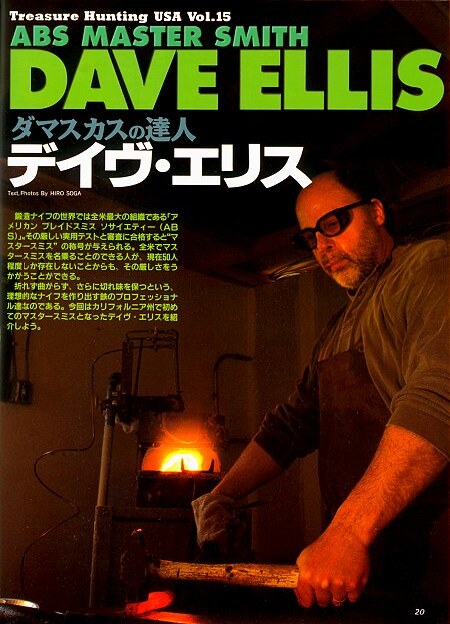
The American Bladesmith Society is the United States' greatest organization in the world of forged knifemaking. If you pass its strict functional test and judging, you receive the title of "Mastersmith." One can imagine its strictness by the fact that at the time, only about 50 people were entitled to carry the name. They are the iron professionals, who create ideal knives that do not break nor bend, and furthermore keep their sharpness. The magazine's introduction: Dave Ellis, the first Mastersmith in California.
The test, as the magazine described it: cut a hanging one-inch manila rope in a single stroke; chop through pine 2x4s and then, without touching up the edge, shave hair; clamp the blade in a vise and bend it upright, where a break or crack means failure. Pass that and you are a Journeyman. To become a Master, you do it again, with a Damascus blade of your own making: functional and beautiful.
Born to teach
The writer met Dave while interviewing maker Michael Manabe. The person who lightheartedly came into the shop saying "Hey, what's up?" was Dave Ellis. Michael credited his own path into forged knives to meeting Dave: "Dave told me there is no secret in knife making. He gave me a hammer and told me to hammer away. Right after a brief lecture, the fire was lit in the forge. When I became aware of what was going on, I'd already finished hammering."
"The way Dave teaches is very logical and easy to understand," Michael continued. "He answers my questions right on. Soon I was able to understand heat treatment, which I had thought was difficult."
Dave, then busy hosting sharpening seminars, put it this way: "Teaching itself is such fun. There is nothing more wonderful than this: by teaching and showing my students, they can learn in one hour what took me a whole year to understand. Such knowledge is a good tradition that can be passed down from one to another."
The writer's verdict: "Indeed, he was born to teach. A person like him is suitable to be called the Master."
Wire Damascus
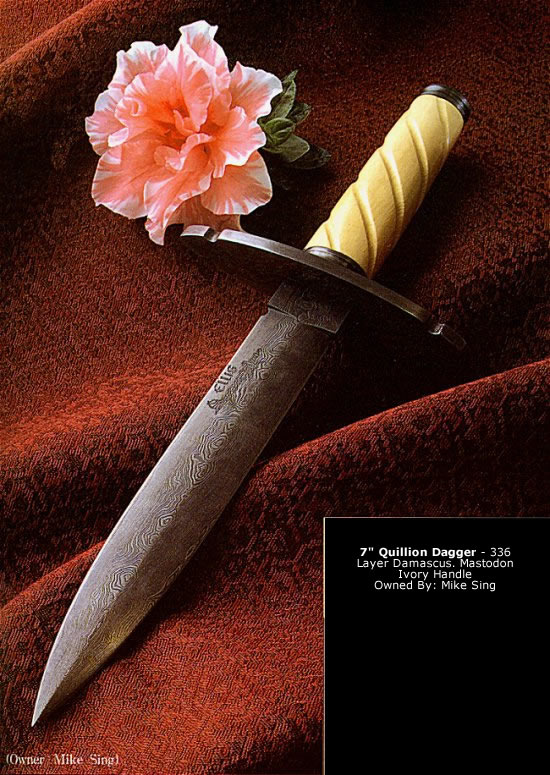
Damascus divides into two big groups: pattern Damascus, made by folding two or more kinds of steel, and Damascus made directly from material such as wire or cable. In pattern Damascus the maker controls the pattern by scraping, twisting, or melting patterns together. Wire Damascus changes its figure depending on the quality and size of the raw material; you can't tell its pattern until it is almost finished, so there is a certain element of risk involved.
The writer had fallen in love with a wire Damascus knife obtained in a trade, and was amazed by its "never failing sharpness" after hard camp use. Dave's explanation: under a microscope, the edge of a wire Damascus knife shows detailed notches created in its formation, which is why its sharpness on soft material lasts so long.
"The more you beat it, the Damascus's charm will become deepened," Dave said. "Certainly, it is difficult. But I always have a feeling of accomplishment in controlling iron, thinking next time I'll bring a change here or there."
In the shop
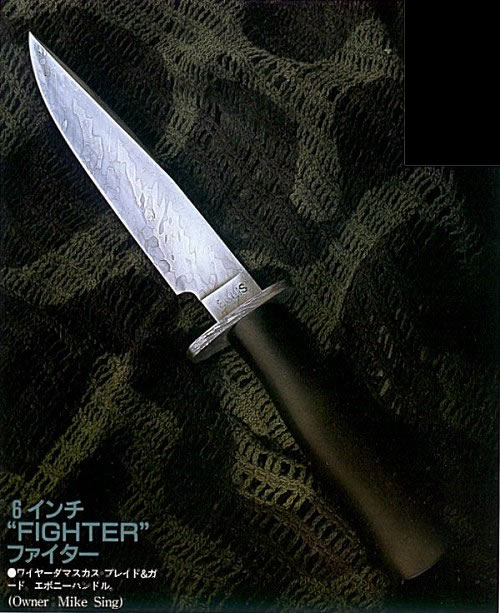
The interview took place in Dave's workshop, remodeled from his garage, where "in part of him lies the spirit of Harley-Davidson." Dave on the craft: "Knife making is a challenging task. Experience and knowledge make a difference. During forging, if you become lazy about brushing, impure material will be mixed into the formation. It will appear as tiny spots at the time of hand polishing. Then it's all over."
He showed the writer a wire Damascus fighter in progress, and pointed out a 1.5-millimeter scar near the ricasso: "I'm keeping this as a lesson never to make the same mistake again."
On selecting raw material: "How much carbon the iron contains decides the quality of the blade. Put it to a grinder and observe the sparks. Fine whitish sparks mean high carbon. Long orange sparks mean the iron is not suitable for a knife."
Forging, step by step
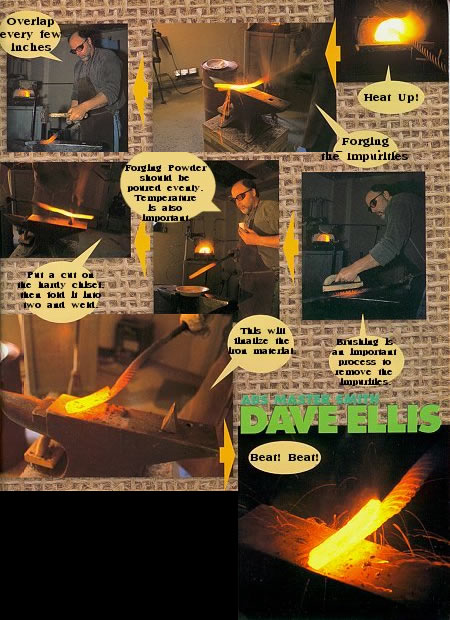
The feature documented Dave's wire Damascus process across several photo pages: weld the cut wires, heat and brush away impurities, twist the heated bundle tight in the press, flux and beat it into one billet. "The person who is beating can tell by feeling the moment wires change into iron. The noise changes from a dull sound to a high-pitched pinging sound."
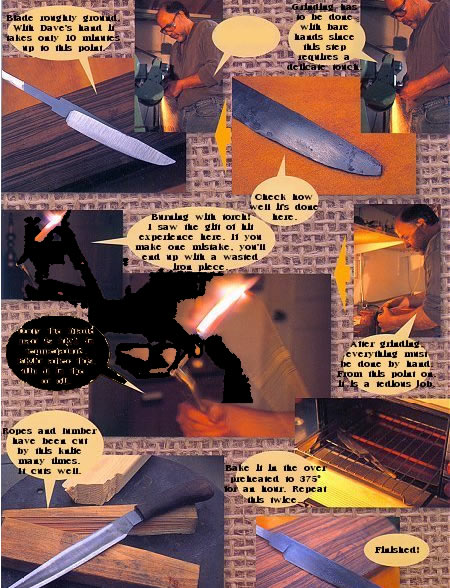
Then: cut to length, forge to shape (tang, spine, edge), hammer the taper into the edge for toughness, cool, grind coarse to fine. From there Dave never used power tools; everything was finished by hand. Harden the edge with the torch to non-magnetic and quench in oil, temper in the oven at 375°F, etch in acid until the pattern comes out, blue if desired, then fit guard and handle.
The showcase
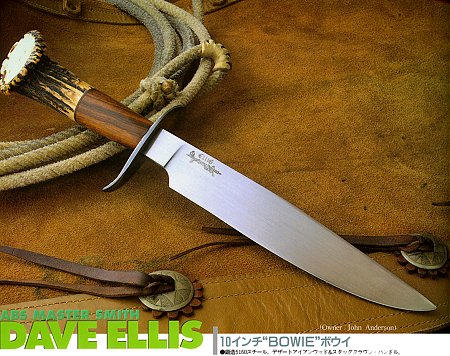
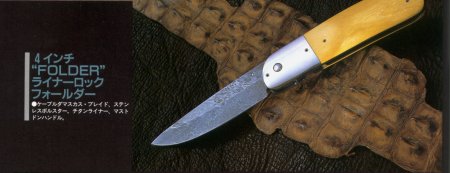
The feature closed with a showcase of finished Ellis pieces, most of which you can see in the gallery: the 6½″ ladder-pattern fighter, the 1,280-layer City Knife, the cable-Damascus "samurai blade" fighter, plus a 4″ Lighter Rock folder in cable Damascus with stainless bolster and mastodon ivory, and Dave on his Harley-Davidson.
"Hello from Dave to people in Japan"
The article ended with a letter from Dave, which deserves preserving word for word:
Hi! People in Japan. I heard that there are a lot of knife fans in Japan too. I'm so glad to hear that. Knife making is one form of art, but the product of the art is actually a practical tool. In that sense, I think forged knives are a wonderful means to show a maker's purpose clearly. Don't think too hard. Just try it once. If you see me at a show somewhere, don't hesitate to talk to me. Look at my Website (Homepage). E-mail address is attached on the site. If you have any questions, just send me an e-mail anytime.
See Ya!
Twenty-some years later, the invitation still mostly stands: Dave is at the shows as a dealer now, the website is this one, and the stories continue on YouTube. Curious about the knives from the article? Browse the gallery.